Top speed / boost
280 / 350 m/s
 E:D Black Box
Zorgon Peterson designed the Mandalay around the SCO frame shift drive from the ground up — light hull, native overcharge handling, transparent cockpit floor for planetary work, and fuel economy that keeps heat down across a thousand-jump expedition. At or near the top of the entire exploration class: the longest practical jumps of any medium, purpose-built SCO handling, and a superb canopy for exobiology. Only the Anaconda's sheer module room and the Caspian's scale carve out niches the Mandalay doesn't fill.
This ship's 1–100 suitability rating reflects its fully-engineered fit for this role, scored against every ship in the role. See how ships are rated.
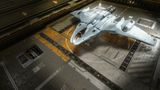
The Mandalay is the first ship designed natively for the Supercruise Overcharge era. Where older explorers bolt an SCO drive onto a hull built for normal flight, the Mandalay's whole design — light mass, advanced micro-thrusters, generous power for the drive — assumes you'll be overcharging between stars. The result is a ship that jumps further and travels through systems faster and cooler than its rivals.
For the explorer it checks every box: a class-leading engineered jump range, a class-5 power plant feeding a willing SCO FSD, a size-6 fuel scoop slot like the Asp and Phantom, and a transparent cockpit floor with the boarding ramp beneath it that makes lining up exobiology landings genuinely easy. Frontier themselves position it as out-ranging the Anaconda — and in practice, for a medium-pad explorer, nothing reaches further.
Long-range expeditions, exobiology tours, neutron highway runs and road-to-riches first-discovery sweeps. Its SCO handling and transparent floor make planetary scanning and deep-black travel a pleasure.
Four things put the Mandalay at the top of the exploration class:
The Anaconda carries more modules and can self-repair more redundantly on a months-long expedition; the Caspian Explorer is a far larger platform for crewed deep-space operations. Neither out-ranges the Mandalay in practice, and both need a large pad. The Mandalay's only real 'ceiling' is module count, not capability — for the vast majority of expeditions it is the best tool for the job.
Class-leading ~85+ LY engineered range, SCO-native cool running and an exobiology-grade transparent floor carry the score; only its medium-hull module count caps it below the very top.
The 96/100 headline is a verdict against the exploration role's priority-ordered factors. Each factor carries a weight (its share of 100); this hull earns part of each based on how it performs against the whole field. The points sum to the rating.
| Role factor | Score | Why this score |
|---|---|---|
| Engineered jump range | 35/35 | Engineered jumps past ~85 LY with a Guardian booster — the furthest of any medium and beating the Anaconda's ~80 LY benchmark, from a light 230 t hull on an SCO-native class-5 FSD. |
| Heat profile | 15/15 | Built for SCO from the ground up: better Supercruise Overcharge fuel economy plus a G5 Low Emissions class-5 power plant keeps it very cool for close scooping and neutron supercharging. |
| Fuel tank & reach | 9/10 | Size-6 fuel scoop slot (matching Asp/Phantom) and a 5C fuel tank give long legs, but the FT5 tank trails the larger reserves of the Anaconda and Phantom on multi-jump SCO legs. |
| Canopy & visibility | 10/10 | Transparent cockpit floor with the boarding ramp beneath gives a clear view straight down — first-try exobiology landings, a class-leading canopy edge the Asp and DBX can't match. |
| Internals | 17/20 | Ten optional internals (6·5·4·4·3·3·2·1·1·1) and 4 utility mounts fit full expedition kit — scoop, twin AFMU, SRV bay, bi-weave, DSS — but the Anaconda and Python carry more module room. |
| Comfort & cost | 10/10 | ~16.5M Cr hull with no rank or permit gate, medium pad, and 2 crew seats; cheap to run and outfit, though Odyssey/ARX is required to unlock and it lacks a large ship's living space. |
| Weighted total | 96/100 | Matches the headline suitability rating for this ship in this role. |
Weights are an editorial decomposition of the role's stated priority order — not an in-game formula. Bar length shows how fully each factor is earned; the longest factors carried the score, the shortest are where it gave points away. See how ships are rated.
Every table rates ships for exploration specifically, split by landing-pad class. The Optional cap. column is total optional-internal capacity — room for scanners, AFMU and fuel; the rating is the same 1–100 suitability verdict used across the site.
| Ship | Class | Optional cap. | Pros & cons | Rating |
|---|---|---|---|---|
| Mandalay this | Medium | ~154 t | — this hull (baseline) | 96 |
| Krait Phantom | Medium | ~190 t | Internals; heatLower-rated; comfort/value | 93 |
| Asp Explorer | Medium | ~130 t | Canopy; internalsLower-rated; jump range | 86 |
| Krait Mk II | Medium | ~230 t | Internals; comfort/valueLower-rated; heat | 80 |
| Python | Medium | ~294 t | Fuel reach; internalsLower-rated; jump range | 75 |
| Asp Scout | Medium | ~74 t | Comfort/value; heatLower-rated; jump range | 70 |
| Type-6 Transporter | Medium | ~114 t | Comfort/value; internalsLower-rated; jump range | 68 |
| Corsair | Medium | ~318 t | Comfort/value; internalsLower-rated; jump range | 58 |
| Type-11 Prospector | Medium | ~288 t | Fuel reach; internalsLower-rated; jump range | 55 |
9 medium-pad exploration hulls carry a rating, led by Mandalay (96). Every same-pad rival lands where this one does — the direct field to shop.
| Ship | Class | Optional cap. | Pros & cons | Rating |
|---|---|---|---|---|
| Anaconda | Large | ~470 t | Fuel reach; internalsLower-rated; canopy | 94 |
| Caspian Explorer | Large | ~434 t | Fuel reach; canopyLower-rated; comfort/value | 94 |
| Imperial Clipper | Large | ~250 t | Internals; comfort/valueLower-rated; jump range | 63 |
| Orca | Large | ~194 t | Canopy; fuel reachLower-rated; jump range | 63 |
| Beluga Liner | Large | ~370 t | Internals; fuel reachLower-rated; jump range | 58 |
The large-pad exploration field (5 rated), led by Anaconda (94) — bigger pads and bankrolls. They out-muscle this hull on the numbers, but sit a pad class away.
| Ship | Class | Optional cap. | Pros & cons | Rating |
|---|---|---|---|---|
| Diamondback Explorer | Small | ~60 t | Heat; comfort/valueLower-rated; internals | 88 |
| Dolphin | Small | ~88 t | Heat; comfort/valueLower-rated; jump range | 80 |
| Diamondback Scout | Small | ~32 t | Heat; comfort/valueLower-rated; internals | 74 |
| Imperial Courier | Small | ~34 t | Jump range; canopyLower-rated; internals | 73 |
| Cobra Mk V | Small | ~110 t | Internals; comfort/valueLower-rated; jump range | 72 |
| Cobra Mk III | Small | ~64 t | Canopy; internalsLower-rated; heat | 71 |
| Hauler | Small | ~26 t | Comfort/value; jump rangeLower-rated; internals | 62 |
| Adder | Small | ~30 t | Comfort/value; fuel reachLower-rated; internals | 60 |
| Kestrel Mk II | Small | ~70 t | Fuel reach; canopyLower-rated; comfort/value | 50 |
The small-pad exploration field (9 rated), led by Diamondback Explorer (88) — cheaper hulls and tighter pads. They undercut this hull on the numbers, but sit a pad class away.
The Mandalay's hull is around 16.5M Cr for Odyssey owners buying with credits (non-Odyssey owners must unlock it with ARX first). There is no rank or permit gate. For a top-tier explorer that's reasonable — comparable to a Krait Phantom and far below a fully-kitted Anaconda.
Outfitting for exploration is cheap relative to combat: lightweight low-class modules, a fuel scoop, scanners and a Guardian FSD booster (a tech-broker unlock, not a purchase). The big one-time cost is the engineering grind for the FSD and thrusters.
The Mandalay was an ARX early-access hull before its credit release. If you hold an ARX pre-built variant, the standard rule applies: stock modules sell for 0 Cr and can't be stored, but engineering the stock cores in place keeps the free rebuy.
The Mandalay launched in two ARX pre-built variants — a Standard package (basic pulse lasers and cargo racks) and a Stellar package (upgraded weapons and a full planetary-exploration fit). Both follow the pre-built rules.
If you own a pre-built, never strip the stock modules: add only to empty slots and engineer the stock cores where they sit to preserve the free rebuy.
| Variant | Standard / Stellar (ARX pre-built) |
|---|---|
| Standard fit | Basic pulse lasers, cargo racks |
Build around the stock fit, not over it — engineer the cores in situ, fill empty optionals with exploration kit, and keep the rebuy free.
A long-range exploration fit. Initial is a buy-only starter; A-rated is the expedition baseline; Engineered is the max-range end-state with a Guardian FSD booster and lightweight everything. The hull ships with an SCO FSD, so it jumps and overcharges well from the very first pad.
| Slot | Initial · buy-only | A-Rated · no eng | Engineered | Notes |
|---|---|---|---|---|
| Utility Mounts | ||||
| Utility 1 | — | 0I Heat Sink Launcher | G1 Ammo Capacity (no experimental effect) | Optional / low-priority — Ammo Capacity adds heat-sink charges. Dumps heat for silent running and Thermal-Vent resets. |
| Utility 2 | — | 0I Heat Sink Launcher | G1 Ammo Capacity (no experimental effect) | Optional / low-priority — Ammo Capacity adds heat-sink charges. Dumps heat for silent running and Thermal-Vent resets. |
| Utility 3 | — | 0A Shield Booster | G3 Thermal Resistant (no experimental effect) | One booster lifts the light bi-weave enough to survive a bad landing; Heavy Duty is the cheapest MJ. |
| Core Internals | ||||
| Bulkheads | Lightweight Alloy | Lightweight Alloy | G5 Lightweight (no experimental effect) | |
| Power Plant | 5E Power Plant | 5D Power Plant | G5 Low Emissions + Thermal Spread | D-rated to shed mass; Low Emissions runs it cold for close scooping and neutron jumps, with ample power for an unarmed hull. |
| Thrusters | 5E Thrusters | 5A Thrusters | G5 Dirty Drive Tuning + Drag Drives | A-rated + Dirty Drives for safe high-gravity landings and quick escapes from a gravity well. |
| Frame Shift Drive | 5A Frame Shift Drive | 5A Frame Shift Drive | G5 Increased Range + Mass Manager | The single biggest range lever — A-rated SCO drive with Increased Range and Mass Manager for maximum jump distance. |
| Life Support | 4E Life Support | 4D Life Support | G5 Lightweight (no experimental effect) | D-rate to save mass, Lightweight trims more; life support has no experimental effect. |
| Power Distributor | 5E Power Distributor | 5D Power Distributor | G3 Engine Focused + Stripped Down | D-rated and stripped of mass; Engine Focused gives the ENG capacity for repeated boosts off planets. |
| Sensors | 5E Sensors | 5D Sensors | G5 Lightweight (no experimental effect) | Drop to D and go Lightweight; exploration needs no sensor range, so save every kilogram. |
| Fuel Tank | 5C Fuel Tank | 5C Fuel Tank | (No blueprint available) | Stock C-rated tank; fuel capacity is fixed and cannot be engineered. |
| Optional Internals | ||||
| Size 6 | 6E Fuel Scoop | 6A Fuel Scoop | G5 Shielded (no experimental effect) | Optional / low-priority — Shielded hardens the scoop; scoop rate is unchanged. Refuels from stars. |
| Size 5 | 5E Cargo Rack | 5H Guardian FSD Booster | (No blueprint available) | Largest Guardian FSD Booster — a flat jump-range gain from a tech broker; not engineerable. |
| Size 4 | — | 4A AFMU | G5 Shielded (no experimental effect) | Optional / low-priority — Shielded hardens the AFMU. Repairs modules between fights. |
| Size 4 | — | 4C Bi-Weave Shield Generator | G3 Enhanced Low Power + Stripped Down | Light bi-weave for crash insurance; Enhanced Low Power plus Stripped Down keep its mass and draw minimal. |
| Size 3 | — | 2H Planetary Vehicle Hangar | (No blueprint available) | One-SRV planetary hangar under-fills the size-3 slot for surface prospecting; not engineerable. |
| Size 3 | — | 3A AFMU | G5 Shielded (no experimental effect) | Optional / low-priority — Shielded hardens the AFMU. Repairs modules between fights. |
| Size 1 | — | 1I Detailed Surface Scanner | G5 Expanded Probe Scanning Radius (no experimental effect) | Optional / low-priority — Expanded Probe Scanning widens probe coverage. Maps planets for exploration data. |
| Size 1 | — | 1E Module Reinforcement | (No blueprint available) | Light module reinforcement spreads damage from a hard landing across the internals; not engineerable. |
| Open in planner / Export | ||||
| Open in Coriolis | open | open | open | One-click open at coriolis.io. |
| Open in EDSY | open | open | open | One-click open at edsy.org. |
| Copy SLEF | Copies the raw Ship Loadout Export Format for that state. | |||
The Guardian FSD Booster (a flat jump-range gain unlocked at a Guardian site) and the fuel scoop (so you never strand) are non-negotiable. A planetary SRV bay and at least one AFMU round out a self-sufficient expedition fit; everything else is comfort.
Fly the hull off the pad — the SCO FSD ships A-rated from the start, so even buy-only it jumps and overcharges well. The Lightweight Alloy bulkheads are the stock hull plate; there is nothing to buy there and nothing heavier you want on an explorer.
Drop a 6E Fuel Scoop into the class-6 slot; never leave the bubble without it. The size-5 slot ships a 5E Cargo Rack.
Everything else is empty buy-only — every utility mount and the remaining optional slots read —. Hold the shield, twin AFMUs, planetary SRV bay, surface scanner and heat sinks for the A-rated pass.
A-rating priority for an explorer — range and self-sufficiency first:
Every kilogram you remove and every grade on the FSD adds light-years. Prioritise the FSD, then mass reduction, then the Guardian booster — in that order. Even the hull plate is the lightweight blueprint; nothing here is carried for armour.
The exploration engineering pass is about range and self-sufficiency, not power. Pin blueprints for remote application; the Mandalay's SCO FSD responds especially well to Increased Range.
| Module | Blueprint | Experimental | Engineer |
|---|---|---|---|
| FSD (SCO) (5) | Increased Range (G5) | Mass Manager | Felicity Farseer |
| Thrusters (5) | Dirty Drive Tuning (G5) | Drag Drives | Professor Palin / Mel Brandon |
| Power Plant (5) | Low Emissions (G5) | Thermal Spread | Hera Tani |
| Power Distributor (5) | Engine Focused (G3) | Stripped Down | The Dweller |
| Life Support (4) | Lightweight (G5) | (none) | Etienne Dorn |
| Sensors (5) | Lightweight (G5) | (none) | Bill Turner / Juri Ishmaak |
| Bi-Weave Shield (4) | Enhanced Low Power (G3) | Stripped Down | Lei Cheung |
| Shield Booster | Heavy Duty (G3) | Super Capacitors | Didi Vatermann |
| Bulkheads | Lightweight (G5) | — | Selene Jean |
Light-to-moderate — exploration blueprints (Increased Range, Lightweight) lean on raw and encoded materials you gather naturally while flying. The FSD G5 is the only demanding one. Ask for exact per-blueprint counts if you want to verify before a long trip.
Approximate progression across the three states (figures are representative, not exact rolls):
| Stat | Initial | A-rated | Engineered |
|---|---|---|---|
| Max jump (laden) | ~38 LY | ~55 LY | ~85+ LY |
| Top speed (boost) | 350 m/s | 350 m/s | ~400 m/s |
| Heat (scooping) | moderate | low | very low |
| Self-sufficiency | none | AFMU×2 + SRV | AFMU×2 + SRV (hardened) |
| Mass (laden) | high | reduced | minimal |
Engineering more than doubles jump range — from a stock ~38 LY to 85+ LY laden — while cutting heat and mass. Mass discipline runs all the way down to the hull: the Lightweight Alloy bulkheads carry the Lightweight blueprint, not armour, and the Power Plant runs Low Emissions + Thermal Spread for the lowest heat-per-output while scooping. That range, combined with SCO travel speed, is what makes the Mandalay the fastest hull to actually get anywhere in the galaxy.
Start with the exploration loop from any bubble station, then range outward. For exobiology, target systems with many landable, atmospheric or icy bodies; the Mandalay's landing ease pays off most on rough terrain.
The Mandalay is the explorer's explorer for the SCO era: the longest practical range of any medium, native overcharge handling, and a cockpit built for planetary science. The Anaconda still wins on module count for the longest crewed hauls, but for the overwhelming majority of expeditions the Mandalay is simply the best ship for getting there, scanning it, and coming home — faster and cooler than anything in its class.
Figures on this page are verified against the sources below.